
The Dust Truth: It’s Not Just Dead Skin (What 50% Actually Is Will Worry You)
If you have ever searched for “what is dust made of” online, you have almost certainly encountered the same visceral statistic. It is the kind of “fun fact” that makes the rounds at dinner parties and makes everyone uncomfortably glance at the corners of their crown molding. The claim is simple, memorable, and repulsive. “80% of household dust is just dead human skin.”
It creates a grotesque mental image. We imagine ourselves slowly disintegrating, shedding our outer layers until they coat our bookshelves and accumulate under our beds like snow. It frames dust as a purely biological problem, a natural and unavoidable consequence of being alive in a space. We accept it because it feels personal. It is just “us,” distributed across the floor.
But here is the reality that science has been trying to communicate for decades. That statistic is a complete myth.
While dead skin is certainly a component of the gray fluff you wipe off your television stand, it is rarely the majority. In fact, comprehensive analyses like the landmark Canadian Dust Study have demonstrated that in many rooms, skin cells constitute less than 50% of the burden. In high-traffic living areas like kitchens and hallways, that number often drops to closer to 20%. The composition of dust varies wildly depending on the room, the number of occupants, the climate, and the age of the building.
So if it is not just human debris, what exactly are you inhaling? The answer is far more complex and potentially more concerning than simple biological waste. Your household dust is not just dirt. It is a chemical reservoir, a concentrated archive of every industrial material, outdoor pollutant, and synthetic compound that enters your home.
This “Toxic Sponge” effect is the real story. While we worry about the “gross” factor of skin flakes, we should be investigating the invisible chemistry. Dust concentrates semi-volatile organic compounds (SVOCs) like phthalates and flame retardants from your modern furniture and electronics. You are not just breathing biological leftovers. You are breathing a concentrated distillation of your home’s industrial materials.
The “Dead Skin” Myth: Why the Internet Got It Wrong
The widespread belief that dust is 80% skin is a misinterpretation of data that fails to account for the massive volume of inorganic and outdoor particles in modern homes. Real-world studies consistently show skin content ranges from 20% to 50%, with the remainder being a chaotic mix of textile fibers, soil, and polymers.
The persistence of the “80% skin” myth tells us more about human psychology than it does about environmental science. We are fascinated by our own biology, and there is a shock value to the idea that we are wading through our own detritus. It is a compelling narrative. However, the math simply does not hold up when you look at the physical mass of dust collected from a typical home.
Consider the physics of shedding. Yes, an average adult sheds roughly 0.03 to 0.09 grams of skin per hour. While this sounds like a lot over a lifetime, much of it is washed away in the shower, trapped in clothing that is laundered, or eaten by microscopic entities. It does not all end up on the floor.
Now consider where the bulk of dust actually originates. If you wear shoes indoors, you are tracking in heavy soil, road particulates, and pollen with every step. If you open a window, soot and combustion byproducts drift in. If you have carpet, curtains, or a sofa, those textiles are constantly shedding microscopic fibers. These sources add mass much faster than your skin does.
When researchers actually analyze samples under a microscope and through chemical assays, they find a chaotic mix. In bedrooms, the skin content is naturally higher because that is where we spend eight hours a night shedding directly into our sheets. But in a living room or kitchen? The “skin” theory falls apart. The dominant particles there are often degraded food debris, dried lint from clothing, track-in dirt, and starch particles.
The implications of this correction are significant. If we believe dust is just “us,” we treat it as a hygiene issue. We think it is gross but harmless. Once we realize it is a mixture of everything else in our environment, including carcinogens and endocrine disruptors, we have to start asking harder questions about what exactly those other things are and how they got there.
The “Toxic Reservoir”: Dust as a Chemical Sponge
Household dust acts as a powerful absorbent for indoor pollutants, trapping heavy molecules like flame retardants and plasticizers that off-gas from electronics and furniture. This makes dust bunnies not just physical nuisances, but concentrated depots of the hazardous chemicals present in your home.
This is the most critical shift in understanding required for the modern homeowner. We tend to think of dust as inert, like sand or dirt. But it is chemically active. It effectively functions as a sponge for the invisible clouds of chemicals that swirl through our homes.
Modern homes are sealed environments filled with synthetic materials. Your television casing is made of plastic additives. Your sofa foam is treated with flame retardants. Your vinyl flooring contains phthalates to keep it flexible. These products are not stable forever. They constantly off-gas semi-volatile organic compounds (SVOCs) into the air.
These chemical molecules are relatively heavy. They do not float around forever. They eventually settle, and when they do, they look for a surface to bind to. Dust particles, with their high surface-area-to-volume ratio and organic content, provide the perfect landing pad.
The Flame Retardant Connection
Flame retardants are a prime example of this phenomenon. Chemicals like PBDEs (polybrominated diphenyl ethers) and their modern replacements are added to furniture cushions and electronics to meet fire safety standards. They are not chemically bound to the foam; they are just mixed in. Over time, they migrate out.
Research from environmental health scientists has consistently flagged this as a major exposure pathway. Because these chemicals bond so well to dust, the concentration of flame retardants in a dust bunny can be orders of magnitude higher than in the air itself or even in the source product’s surface.
This is most concerning for the most vulnerable members of the household: toddlers and pets. They spend their time on the “dust layer,” the floor. Their hands are constantly touching dusty surfaces and then going into their mouths. They are effectively ingesting a high-dose concentrate of whatever chemicals your home is shedding. Studies have found correlations between dust levels of these chemicals and their levels in children’s blood, suggesting dust is a primary route of exposure.
Phthalates and Forever Chemicals
The chemical cocktail does not stop at fire safety. Phthalates, used to soften plastics in everything from shower curtains to vinyl flooring, are ubiquitous in dust samples. So are PFAS, the “forever chemicals” used in stain-resistant treatments for carpets and upholstery. When you see a layer of dust on your bookshelf, you are looking at a physical map of your home’s chemical composition.
If you removed all the furniture and electronics from your house, the toxicity of your dust would plummet. The dust is a mirror of the materials you choose to live with. This transforms cleaning from a chore into a health intervention. You are not just tidying up. You are physically removing a buildup of accumulated industrial toxins.
The Microscopic Zoo: What Else is Living in There?
Beyond chemicals and skin, dust supports a thriving ecosystem of microorganisms, largely driven by dust mites that feed on organic matter and produce allergenic waste. This biological fraction also includes significant amounts of fungal spores and bacteria that thrive in the micro-habitats of your floor.
If the chemical reality is cold and industrial, the biological reality of dust is teeming with life. It is not just dead matter. It is a habitat.
The most famous residents are, of course, dust mites (Dermatophagoides). These microscopic arachnids are the primary reason dust is such a potent allergen for so many people. But here is the nuance that usually gets lost. It is not the mites themselves that cause the sneezing or the asthma attacks. It is their waste products.
Dust mites feed on the organic components of dust. Yes, the skin cells, but also fungal spores and food crumbs. As they digest this buffet, they produce fecal pellets containing powerful enzymes (proteases) that are highly irritating to human lungs and sinuses. A single gram of dust can contain thousands of these mites and millions of fecal particles. They thrive in humidity, making the “dust ecosystem” of a damp coastal home vastly different from that of a dry desert home.
But the zoo is larger than just mites.
The Bacterial Gradient
Studies have shown that the bacterial makeup of your dust can reveal exactly who you live with. Homes with dogs have a distinct bacterial signature in their dust, often more diverse (and arguably healthier) than homes without pets. The “dog dust” tends to be richer in outdoor-associated bacteria like Lactobacillus, which may explain why children growing up with dogs have lower rates of allergies; their immune systems are trained by this richer microbial dust.
Conversely, homes with more women have different bacterial ratios than homes with more men, mostly due to differences in skin flora (like Staphylococcus and Corynebacterium). This “microbial fingerprint” is incredibly resilient. You track in bacteria from the soil outside, and it integrates into the floor community. While most of these microbes are harmless commensals, their presence reminds us that our homes are not sterile boxes. They are biomes.
Fungal spores are another major player. In damp environments, mold contributes significantly to the dust load. These spores can lie dormant in deep carpets for months or years, waiting for humidity to rise so they can bloom.
The Outdoor Invaders
Surprisingly, up to 60% of the material in household dust originates from outside the home, consisting of soil, road particulates, soot, and pollen tracked in or blown through windows. This tracking effect means that the air quality of your neighborhood directly dictates the composition of the dust on your floor.
We tend to think of our homes as fortresses, separate from the world outside. However, the barrier is permeable. The “Indoor-Outdoor” ratio is a key concept in environmental science, and for dust, the balance is heavily weighted towards the outdoors.
Lead is a terrifying example of this intrusion. In older neighborhoods or areas near industrial zones, lead from soil (a legacy of leaded gasoline and exterior paint) is tracked indoors on shoes. Once inside, it settles into carpets and becomes part of the house dust. It does not break down. It just accumulates. A study in urban homes found that lead levels in interior dust were directly correlated with the soil lead levels outside the front door.
The Shoe Factor
This is why the “no shoes inside” rule is one of the single most effective things you can do for indoor air quality. It is not just about keeping the carpet looking clean. It is about blocking the physical transport mechanism for heavy metals, pesticides, and road grime.
Soot is another external invader. If you live near a busy road, a significant portion of your blacker dust is actually carbon particulate from vehicle exhaust. It floats in through open windows or vents, or even infiltrates through cracks in the building envelope, and adds to the “inorganic” fraction of your dust load.
When you start seeing dust as an infiltration of the outside world, the “dead skin” myth seems even more absurd. We are worrying about our own shedding while hauling in the street on the soles of our sneakers.
How to Manage the Micro-Ecosystem
Effective dust management requires shifting from “moving it around” to “physically removing” the chemical and biological load through high-efficiency filtration and wet cleaning. The goal is to break the cycle of accumulation rather than simply launching particles back into the air.
Now that we understand what dust actually is, a toxic, biological, chemical reservoir, we have to change how we fight it.
The traditional image of a maid with a feather duster is outdated and counterproductive. Feather dusters do not remove dust. They agitate it. They take a settled chemical reservoir and aerosolize it, making it easier to inhale. This is the opposite of what we want.
The Physics of Capture
To actually clean, you need to capture the particle. This is why damp microfiber is superior to dry cloths. The water tension and the microscopic fibers trap the dust, allowing you to rinse it down the drain systematically rather than flicking it into the air. You are physically exporting the toxins from your home.
Vacuuming is another battleground. If you do not have a HEPA (High-Efficiency Particulate Air) filter on your vacuum, you are often just recirculating the finest, most dangerous particles. The machine sucks up the big visible bunny and blasts out the invisible chemical dust out the back vent. This “fines” fraction is what contains the highest concentration of SVOCs and allergens.
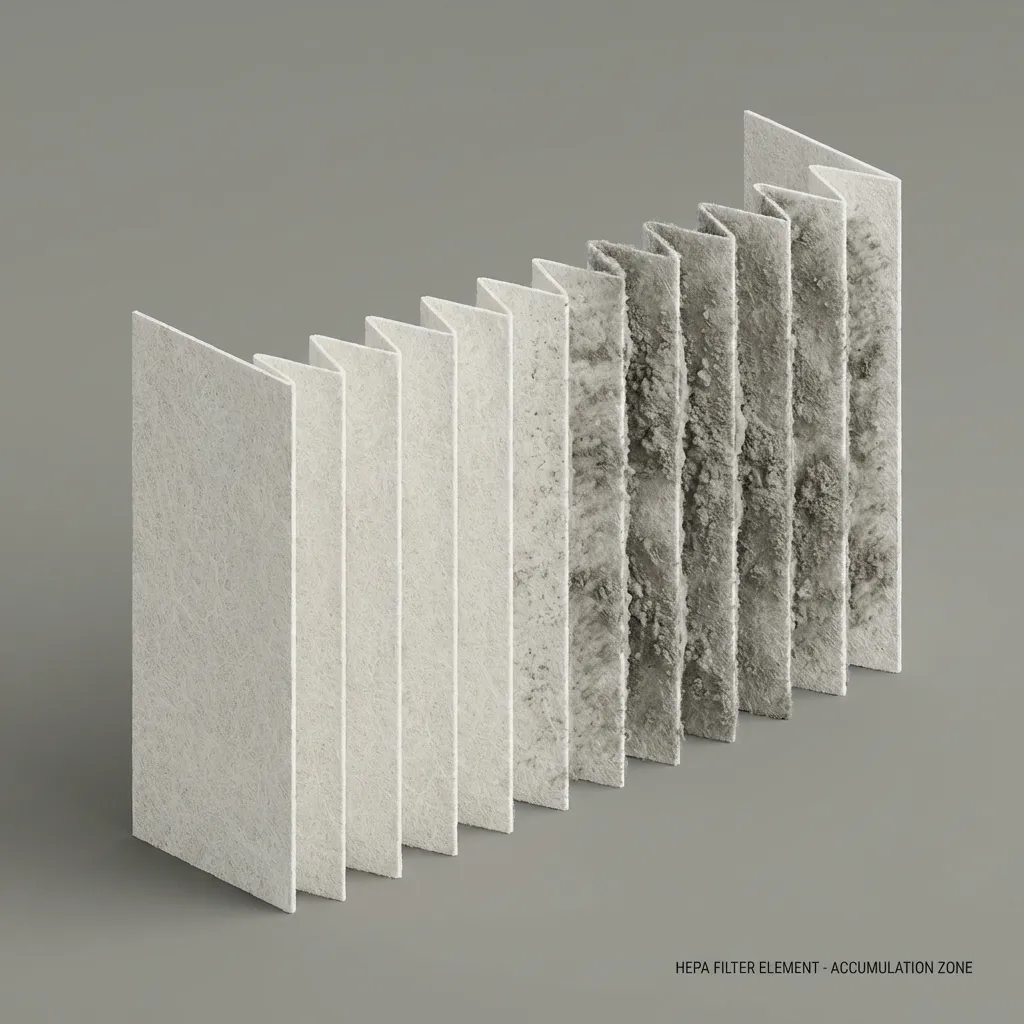
The strategy is simple. Stop tracking it in (shoes off). Trap what settles (wet dusting). Filter what floats (HEPA purifiers).
We cannot create a dust-free world. Entropy guarantees that things will break down, fibers will shed, and soil will intrude. But we can stop fearing the wrong thing. It is not about the horror of dead skin. It is about the reality of modern materials. Your home is a living system, and dust is its memory. Treat it with the respect, and the caution, it deserves.